
The short answer
What should a new arena construction quote cover?
A complete scope should address the riding footprint, site access, earthwork, supporting layers, water-management approach, riding surface and any separately priced fencing or watering. The correct design depends on the parcel, riding use and qualified site assessment.
Source: UGA Cooperative Extension on arena footing. Site-specific decisions require a qualified assessment.
A riding arena should be planned around the property, the horses and the people who will use it. Whether you are adding a private schooling ring or developing a training facility, define the earthwork, drainage and surface together before comparing construction bids.
What belongs in a complete arena build?
Start with the intended riding area and the land around it. A usable arena requires more than a truckload of sand: it needs a supporting structure, a suitable surface and a way for rainwater to leave the site.
- Site evaluation: assess existing elevations, soil conditions, access, nearby structures and likely water routes.
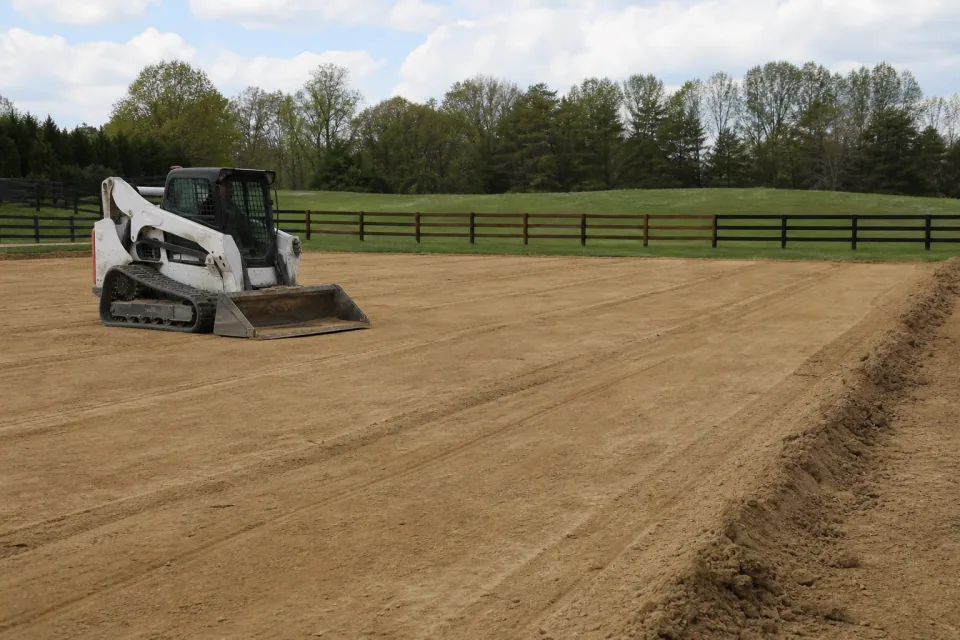
- Earthwork: prepare the site and form the specified elevations, including appropriate measures to manage erosion during construction.
- Foundation and drainage: design the support beneath the riding layer and the route water will take, with stabilization or subsurface drainage where justified.
- Riding surface: select, deliver and distribute the specified material for the intended use.
- Completion: establish acceptance criteria, maintenance instructions and any separately priced fencing, watering or perimeter work.
Choose a location before committing to dimensions
Measure both the desired riding rectangle and the available working space. A site that fits the arena may still lack room for equipment, a material stockpile, a safe approach or a drainage outlet. The cheapest location to clear is not necessarily the most economical location to build.
For Aiken-area properties, ask the contractor to evaluate the actual parcel rather than assuming all local soils behave alike. Note the previous land use, areas that stay wet, elevation changes, buried utilities and how delivery vehicles would reach the site. Include your discipline, expected number of rides per day, grooming equipment and water availability in the brief.
Aiken County’s equine facilities directory lists venues for several disciplines, including dressage, jumping and eventing schooling. That mix makes the intended use of a private or commercial arena especially relevant when planning its dimensions and surface. See our footing guide by discipline for questions to bring to the design discussion.
Ready to plan the work?
Check jurisdiction and disturbance before earthwork
Aiken County Planning & Development issues building permits outside the city limits of Aiken and North Augusta; those cities have their own processes. Confirm which authority covers the actual parcel.
For applicable noncoastal construction disturbing under one acre, SCDES describes a notification and review process. Work within a larger common development plan can require a stormwater permit application even below one acre. Local stormwater authorities may also have requirements. The state describes construction general permit coverage and a stormwater pollution prevention plan for projects disturbing one to two acres.
Count the full proposed disturbance, including grading, access and staging, not only the finished riding rectangle. Ask the appropriate authorities and qualified professionals to confirm permits, exemptions, wetlands, drainage discharge and property constraints before work begins. An agricultural or private use label does not settle the question.
See the Aiken arena permits and planning guide for the local review contacts and a disturbance checklist.
What to prepare for a new arena quote
- Property ZIP code and proposed location, with approximate riding dimensions.
- Current site condition, preferred riding discipline and use frequency.
- Photos or a sketch showing slopes, access routes and nearby buildings, if available.
- Preferred timeframe, budget priorities and whether fencing or irrigation belongs in the scope.
Ask for an itemized proposal with the assumptions behind material quantities, earthwork, drainage, disposal, permits and potential changes in scope. Compare the proposed finished system and its upkeep, not just the price per square foot.
Use the arena size and material calculator to record dimensions, and the construction cost guide to compare proposal components.
From site preparation to finished riding surface
- Confirm the location, riding footprint, access and approvals before clearing or ordering materials.
- Have the designer or contractor establish the grades, soil suitability and water-management approach.
- Agree the scope for unsuitable material, earthwork, drainage, supporting layers and testing before placing the riding surface.
- Confirm surface specification, perimeter restoration and the written acceptance and maintenance plan.
Ask who coordinates each phase and how changes to scope are priced. The order is a project-planning sequence, not a prescribed construction specification. For a discipline-specific layout, see dressage arena construction. If the property already has a ring, compare renovation options first.
What to ask an Aiken-area arena builder about site preparation
When a riding arena is part of a larger equestrian property project, ask which excavation, clearing, access and grading work is actually included in the arena contract. Distinguish the riding rectangle and its supporting layers from work on a barn pad, driveway, pasture or other facilities. Clarify who coordinates equipment access, spoil handling, temporary erosion controls and the final water-management plan.
For a private horse farm or a training facility, the size of the equipment and delivery route can affect the quote. Use the Aiken County project-area guide to check the parcel location, and site planning checklist to prepare a scope before contacting a builder. Standalone land clearing, barn construction and general farm development are not the current referral focus.
Planning an extension to an existing arena
When a ring is too small for the intended training, measure the existing riding area and identify the proposed additional footprint. Ask the contractor to compare retaining the existing surface with rebuilding the join between old and new work. Clarify how the new grades, base layers and drainage will connect, how access and fencing may change, and whether the expanded area affects approvals. Use the arena project finder to prepare a combined-scope request rather than assuming an extension is a simple sand delivery.
Can I build in phases?
Sometimes. A phased project may be sensible if a contractor can design the completed arena and plan each stage around it. Confirm what must be installed together, how unfinished layers will be protected, and whether returning equipment to the site will add cost. Have the completed surface assessed before riding.
How a project request works
Describe your project
Choose the work, property ZIP and timeframe. Add details if you know them.
Review the fit
Identify the work needed, the property conditions and the right scope for an estimate.
Discuss an estimate
Discuss the proposed work, timing and itemized pricing with a contractor.
For property location and planning questions, see the Aiken County project area.
Before you request a quote
What should a new arena quote include?
Ask for site preparation, drainage, foundation, material delivery and installation to be separately identified. The actual scope depends on the property.
Can I plan an arena before choosing the footing?
Yes. Establish intended use, dimensions, site conditions and access first; have a specialist specify compatible layers and materials.
Ready to discuss your project?
Use the interactive new arena planning checklist before requesting a site visit.
Plan your next arena project
Describe the property, work needed and your preferred timing. You can include dimensions and budget if known.
Project enquiriesSources and further reading
- University of Georgia Cooperative Extension, The Dirt on Arena Footing (October 4, 2023) — checked November 24, 2026
- French Institute for Horses and Riding (IFCE), Designing an Arena; technical background, not South Carolina code — checked November 24, 2026
- Aiken County Planning & Development, permit jurisdiction — checked November 24, 2026
- South Carolina Department of Environmental Services, Less than 1 Acre of Land Disturbance — checked November 24, 2026
- South Carolina Department of Environmental Services, 1 to 2 Acres of Land Disturbance — checked November 24, 2026
- Aiken County — Equine Facilities directory (checked November 24, 2026)