
The short answer
Which sand or footing blend is right for an arena?
There is no universal blend for every discipline or existing foundation. Review particle characteristics, intended riding use, moisture needs, maintenance equipment and compatibility with the underlying layers before choosing material.
Source: UGA arena footing guidance. Site-specific decisions require a qualified assessment.
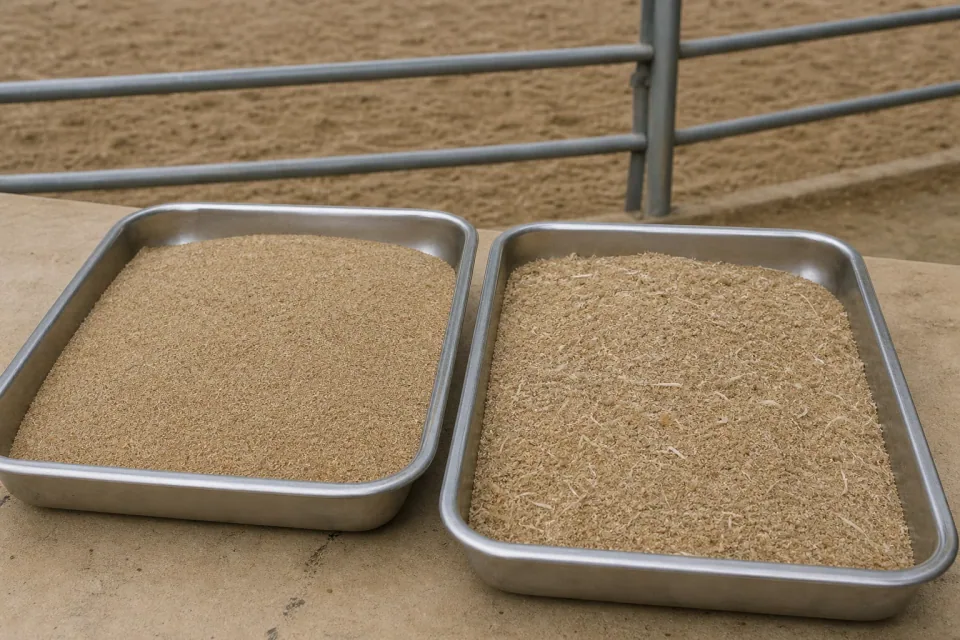
Compare common surface options
Material names alone do not describe how a finished arena will perform. Use these categories as a starting point for a discussion with a specialist, and ask for samples and specifications before ordering.
| Option | What to evaluate | Maintenance considerations |
|---|---|---|
| Arena sand | Grain shape, gradation, fines, durability and compatibility with the base | Watering, redistribution and replenishment |
| Sand with fiber | Sand specification, blend consistency and intended response under use | Blending, moisture needs, suitable grooming equipment |
| Proprietary or engineered blend | Product specification, required foundation and installation method | Supplier maintenance instructions, replacement supply and total upkeep cost |
These categories can overlap; some proprietary systems are themselves sand and fiber blends. Higher initial cost does not automatically make a material better suited to a particular property.
Why sand specification matters
Grain characteristics affect the behavior of the loose surface. Sand with a different distribution of fine particles or different grain shape can respond differently to water and use, even when suppliers describe both products as arena sand. Request a sieve analysis or other appropriate product data and a representative sample. Do not assume that sand from one source can be mixed with another without changing the result.
Discuss dust management, traction, firmness and the expected response to repeated use with the installer. Ask how the specification was chosen for your discipline and how changes in moisture will be managed. No material is injury-proof or suitable for every horse and activity.
What changes when an additive is introduced?
Fibers and other surface additives can alter the way the grains interact. A proposed blend should have a clear purpose and an installation method that is compatible with the supporting layers. Ask whether the material can be supplied already blended, how uniformity will be checked and what equipment is needed to maintain it.
For any additive, request the safety data sheet where applicable, material composition, supplier instructions and end-of-life disposal information. Consider availability of replacement materials and runoff implications before committing to a product.
Choose for the arena you actually operate
A private ring used occasionally and a lesson facility with many daily rides may have different maintenance priorities. Tell the contractor about your mix of disciplines, expected traffic, indoor or outdoor conditions, available water and grooming equipment. In a replacement project, ask about the condition of the base before selecting the new layer.
Agree on a maintenance handoff. Ask how the surface should be checked for uneven depth, how moisture should be managed, when to redistribute or replenish material and how to avoid disturbing the foundation. Have any unexpectedly unstable surface assessed before use.
See the discipline comparison and maintenance planning guide for questions about daily use and upkeep.
Check material performance and upkeep together
Ask the supplier and installer how they evaluate a sample, what specification and quantities are quoted, and which moisture and grooming conditions the material needs. Consider whether your maintenance resources match the proposed surface. If dust is a recurring concern, see the dust and moisture guide. If the arena is under cover, review covered arena surface considerations.
Prepare for a material evaluation
Before buying replacement sand or an additive, organize the information a material specialist would need: the current surface and any known blend, supplier specification or gradation report, riding discipline and frequency, recurring symptoms, and watering and grooming practices. Include whether problems are isolated or widespread and whether they change after rain. Ask the specialist whether representative sampling is needed and follow their sampling instructions rather than disturbing supporting layers. Ask for written results, an explanation of what they mean for your ring, and the proposed blend and upkeep requirements. A material review is not a substitute for checking drainage and base condition. Aiken Horse Arena Construction does not provide laboratory testing.
Before ordering material
- Get the riding-layer specification and planned depth from an appropriate professional.
- Confirm the existing or proposed foundation is compatible.
- Compare supplier data, sample material and installed scope.
- Confirm delivery quantities and pricing with actual suppliers, including freight and any special unloading requirements.
- Allow for ongoing upkeep in the budget.
Use the calculator to explore geometric quantities, then seek a supplier and contractor assessment to determine an order amount.
Plan your next arena project
Describe the property, work needed and your preferred timing. You can include dimensions and budget if known.
Project enquiriesSources and further reading
- University of Georgia Cooperative Extension, The Dirt on Arena Footing (October 4, 2023) — checked November 24, 2026
- University of Kentucky Cooperative Extension, Riding Arena Footing: Materials and Characteristics (ID-265) — checked November 24, 2026
- French Institute for Horses and Riding (IFCE), Designing an Arena; technical background, not South Carolina code — checked November 24, 2026