
The short answer
When is arena grading or base repair worth investigating?
Persistent low spots, exposed foundation aggregate, soft areas or uneven support after routine grooming can indicate a problem below the riding layer. Document the pattern and ask a specialist whether localized base repair or broader reconstruction is appropriate.
Source: UGA Cooperative Extension on base and footing. Site-specific decisions require a qualified assessment.
If an arena develops recurring low spots, inconsistent support or exposed foundation material, grooming the top alone may no longer be enough. Grading and base rehabilitation address the supporting profile so a new or recovered riding surface can be installed over a suitable foundation.
Surface grooming and base correction are different scopes
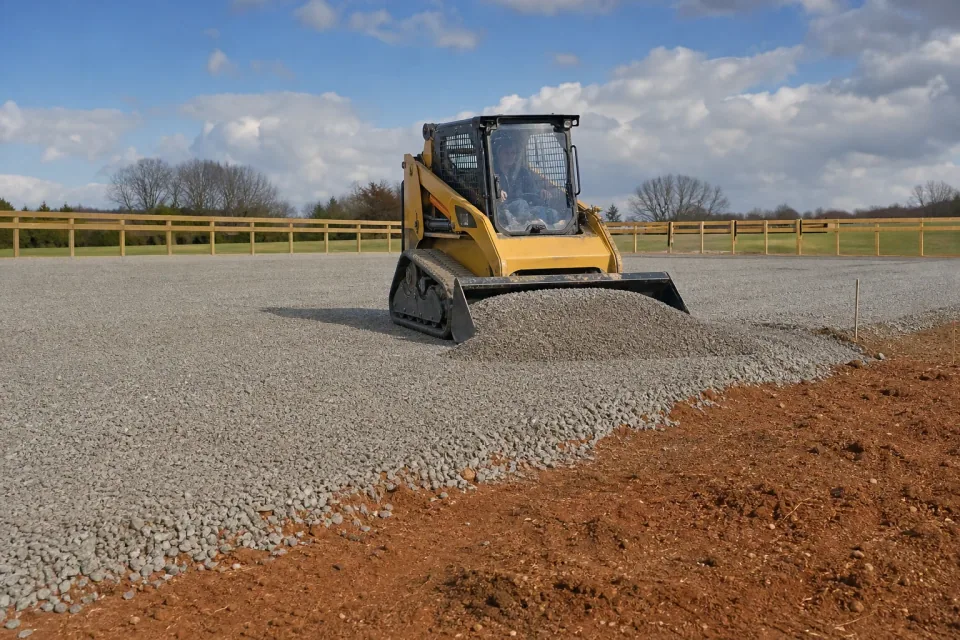
Routine grooming redistributes the loose riding material as it moves under use. Corrective grading may instead involve surveying and restoring the arena's designed profile. Foundation rehabilitation may involve lifting the riding material and reconstructing damaged portions of the support below.
An outdoor arena may have intentional elevation changes to manage water. Ask a contractor to identify the designed profile before requesting that an existing arena be made completely flat.
When the underlying structure needs assessment
The UGA Cooperative Extension footing overview helps distinguish a riding surface from its supporting layers. A qualified local assessment is still needed.
Persistent ridges, hollows that reappear after grooming, visible aggregate mixed into the riding material and localized changes in firmness can justify a professional investigation. Heavy traffic at the entrance or along commonly used tracks may complicate the picture.
Ask for an assessment of the surface depth, underlying support and grade. Existing construction drawings and photographs can help, but the contractor may need to examine selected areas directly. Symptoms alone cannot establish whether damage is limited to one layer. Do not continue riding over a potentially unsafe area.
Ready to plan the work?
What a foundation repair proposal should explain
- Existing conditions: what the contractor observed and which areas require investigation.
- Removal and salvage: whether existing footing can be separated, stored and reused without compromising its quality.
- Correction: how the proposed work restores the intended profile and addresses unsuitable supporting material.
- Water management: whether drainage-related changes are needed before the riding layer is replaced.
- Acceptance: how material placement and the finished profile will be evaluated, and who handles unexpected conditions.
Layer depths, stabilization materials and compaction requirements must be chosen for the site by qualified professionals. A universal specification is not appropriate.
Can you repair one section instead of rebuilding the ring?
A localized repair may be an option if the rest of the structure is in good condition and the cause of failure is understood. A broad reconstruction may be more suitable when the underlying issue is widespread or when previous local repairs have not lasted.
Compare the extent of investigation, material disposal, downtime, and how the repaired area will meet the undisturbed portions. Ask for separate scope and pricing options where feasible. The cost of returning to the site repeatedly belongs in the decision alongside the initial estimate.
When reviewing the alternatives, compare the riding surface replacement scope and drainage restoration scope as separate lines in the proposal.
Investigate recurring deterioration before adding material
Ask the contractor to identify which changes occur in the riding layer and which indicate a possible supporting-layer issue. Compare the pattern with prior grooming, previous repairs and wet conditions. A proposed correction should identify the affected area, the reason for the chosen scope, how sound material will be protected, and whether drainage work is required. Request separate investigation and remedial-work allowances rather than agreeing to an undefined full rebuild.
The repair-versus-rebuild comparison helps organize competing proposals. If buying the property, use the existing arena assessment guide to prepare for an authorized site visit.
When to discuss laser grading and excavation
Laser-guided equipment can help a contractor work to an intended elevation profile. The target grades still need to reflect the site, footing system and drainage design; a flat surface is not automatically the right design. Ask whether the quote covers checking the existing elevations, removing the riding layer, correcting the supporting base and verifying the finished profile. Equipment choice alone does not establish that the underlying support is sound.
For a larger horse-farm grading project, identify the areas that affect the arena, including the approach and perimeter. Request a defined arena scope and separate any unrelated earthwork. Compare the new-build scope and water-management scope if an existing ring needs broader rehabilitation.
Prepare your grading and base repair inquiry
Share the dimensions, surface material if known, visible problem areas, age of the ring, grooming equipment, known drainage features, past repairs and site access. Flag whether the problem changes after rain and whether the entire ring or only a particular area is affected.
If the work involves land disturbance or altered discharge, check the applicable local and state requirements before construction.
How a project request works
Describe your project
Choose the work, property ZIP and timeframe. Add details if you know them.
Review the fit
Identify the work needed, the property conditions and the right scope for an estimate.
Discuss an estimate
Discuss the proposed work, timing and itemized pricing with a contractor.
For property location and planning questions, see the Aiken County project area.
Before you request a quote
Can a contractor correct only part of my arena?
A localized repair may be appropriate when the cause is understood and the surrounding structure is suitable.
Is laser grading the same as rebuilding a base?
No. Laser-guided equipment can help achieve specified grades, but the underlying support and drainage still need assessment.
Plan your next arena project
Describe the property, work needed and your preferred timing. You can include dimensions and budget if known.
Project enquiriesSources and further reading
- University of Georgia Cooperative Extension, The Dirt on Arena Footing (October 4, 2023) — checked November 24, 2026
- French Institute for Horses and Riding (IFCE), Designing an Arena; technical background, not South Carolina code — checked November 24, 2026
- University of Kentucky Cooperative Extension, Riding Arena Footing: Materials and Characteristics (ID-265) — checked November 24, 2026
- Aiken County Planning & Development, permit jurisdiction — checked November 24, 2026
- South Carolina Department of Environmental Services, Less than 1 Acre of Land Disturbance — checked November 24, 2026