
The short answer
What is the first step when a horse arena holds water?
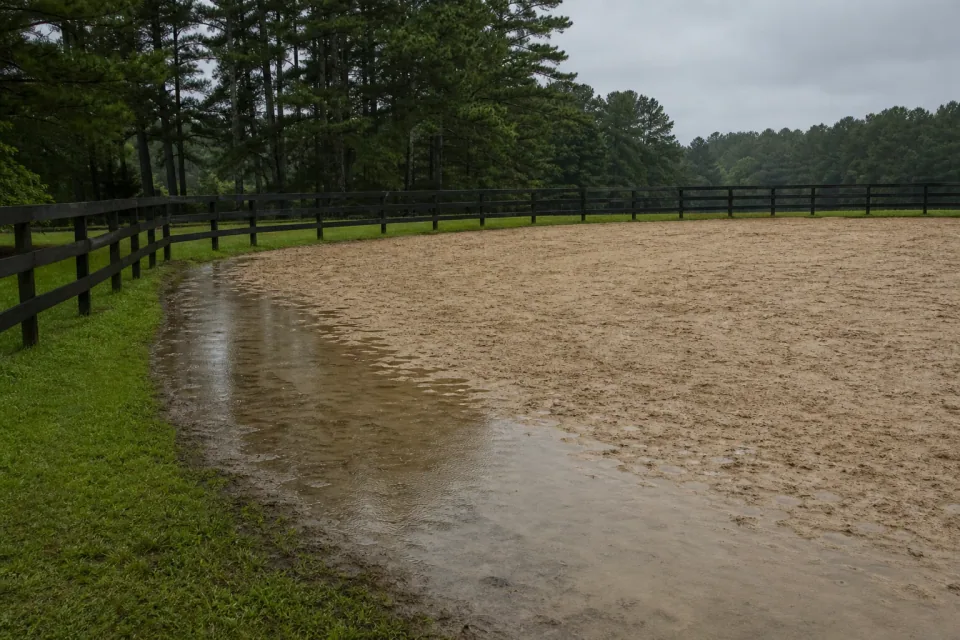
Record where water enters, collects and exits during rain, then ask a qualified contractor to investigate grades, surrounding runoff, supporting layers and available outlets. Adding sand before identifying the cause may conceal the defect.
Source: Aiken County flood and parcel information. Site-specific decisions require a qualified assessment.
An outdoor arena that repeatedly holds water after rain deserves a closer look at the entire site. The useful question is where the water comes from, where it collects and where it can leave. Restoration may involve the riding layer, the perimeter or the structure below it.
Follow the water, from arrival to outlet
Photograph the arena from the same vantage point after several rain events, when it is safe to do so. Record which places become wet first, how much of the ring is affected, and how long visible water remains. Look beyond the fence for signs that surrounding land contributes runoff.
Water may travel across the surface or through permeable layers below it. The appropriate design depends on the existing construction, soils, local rainfall and a suitable discharge route. A subsurface drain cannot be assumed to solve every surface-water problem.
Symptoms worth investigating
- Water collecting in the same place: record the location and whether footing depth appears different there.
- Rills or sand accumulating against a fence: document the material movement and the direction of visible flow.
- Water entering from outside the arena: show the adjacent slopes and any existing channels or roof runoff.
- A ring that stays soft after visible puddles disappear: describe when this occurs and whether the whole arena is affected.
These are clues for a contractor, not a remote diagnosis. Keep horses off a questionable surface until it has been assessed.
Ready to plan the work?
What could a drainage repair involve?
A specialist might propose clearing or repairing an existing outlet, correcting a surface profile, intercepting incoming runoff, restoring permeable layers or reconstructing part of the base. The remedy should address the demonstrated problem and include a realistic plan for inspection and upkeep.
Ask where discharge will go and whether that destination is appropriate and authorized. Changing drainage can affect neighboring property, wetlands, roads or other infrastructure. Do not assume that a ditch, trench or added pipe is appropriate for your parcel.
Aiken County site and stormwater checks
Consult the Aiken County flood information as an initial parcel screening resource, not a determination of site drainage or permitted discharge.
Before a contractor begins clearing, excavation or grading, identify the parcel's local authority. The county's building permit jurisdiction excludes the cities of Aiken and North Augusta. For applicable noncoastal projects smaller than an acre, SCDES describes a notification and review process; larger common plans and local municipal stormwater jurisdictions can trigger additional approval requirements.
Verify the total disturbance and the proposed discharge arrangement with the responsible authorities. Ask who will handle any required permits, erosion controls and restoration of disturbed areas in the written proposal.
Use the local permit and site-planning checklist to prepare for that conversation.
What to document after a washout or erosion event
From a safe location, photograph the upstream ground, water entry points, damaged perimeter, deposited sediment and any known drainage outlet. Record the location and sequence of damage rather than assuming that a low spot is the source. Ask the contractor to explain how the repair will address incoming water, surface profile and downstream effects, and how temporary and permanent erosion controls will be handled. Do not clear an unsafe outlet or divert discharge onto adjacent land without appropriate review.
If the riding layer or foundation has also been displaced, compare the renovation decision guide and base repair scope. Check the local planning requirements for the actual work and disturbance.
Horse farm drainage when runoff reaches the riding arena
On a larger horse property, the water affecting the ring may originate outside it, such as from an access lane, roof or adjoining ground. Include those connected areas in the assessment; do not assume that installing a drain inside the riding rectangle will solve an upstream problem. Map the observed flow, possible outlets and neighboring land before discussing corrective grading or other work.
The county GIS resources and county flood information are useful starting points, not surveys or a determination that work is permitted. Verify conditions and the appropriate reviewing authority. Our project focus is drainage affecting the arena, not general farm drainage or pond construction.
Prepare a drainage repair quote request
- Approximate dimensions and the age or known construction of the arena.
- Photos showing the recurring problem, existing drains or outlets, adjacent terrain and access.
- How the arena behaves during and after rain, and any previous repairs.
- Whether replacement of the riding layer or correction of the base is already being considered.
Ask the contractor to separate investigation, drainage work and surface restoration in the scope. Agree on how the repair will be evaluated and what maintenance is needed. A repair can improve water management, but no outdoor arena is guaranteed usable in every storm.
How a project request works
Describe your project
Choose the work, property ZIP and timeframe. Add details if you know them.
Review the fit
Identify the work needed, the property conditions and the right scope for an estimate.
Discuss an estimate
Discuss the proposed work, timing and itemized pricing with a contractor.
For property location and planning questions, see the Aiken County project area.
Before you request a quote
Can a drain alone fix an arena that holds water?
Not always. The source of water, elevations, foundation and lawful outlet must be considered together.
What should I document for a drainage quote?
Photographs after rain, affected areas, known drains and nearby slopes help a specialist understand the problem.
Plan your next arena project
Describe the property, work needed and your preferred timing. You can include dimensions and budget if known.
Project enquiriesSources and further reading
- French Institute for Horses and Riding (IFCE), Designing an Arena; technical background, not South Carolina code — checked November 24, 2026
- University of Georgia Cooperative Extension, The Dirt on Arena Footing (October 4, 2023) — checked November 24, 2026
- Aiken County Planning & Development, permit jurisdiction — checked November 24, 2026
- South Carolina Department of Environmental Services, Less than 1 Acre of Land Disturbance — checked November 24, 2026
- Aiken County — Maps (County), parcel and GIS resources — checked November 24, 2026
- Aiken County — Flood Information — checked November 24, 2026