
The short answer
How should persistent arena dust be investigated?
First document moisture practices, grooming, material condition and when dust returns. If the problem persists despite suitable care, discuss material breakdown, contamination and replacement with a footing specialist rather than assuming an additive will solve it.
Source: UGA arena footing guidance. Site-specific decisions require a qualified assessment.
Identify when and where dust occurs
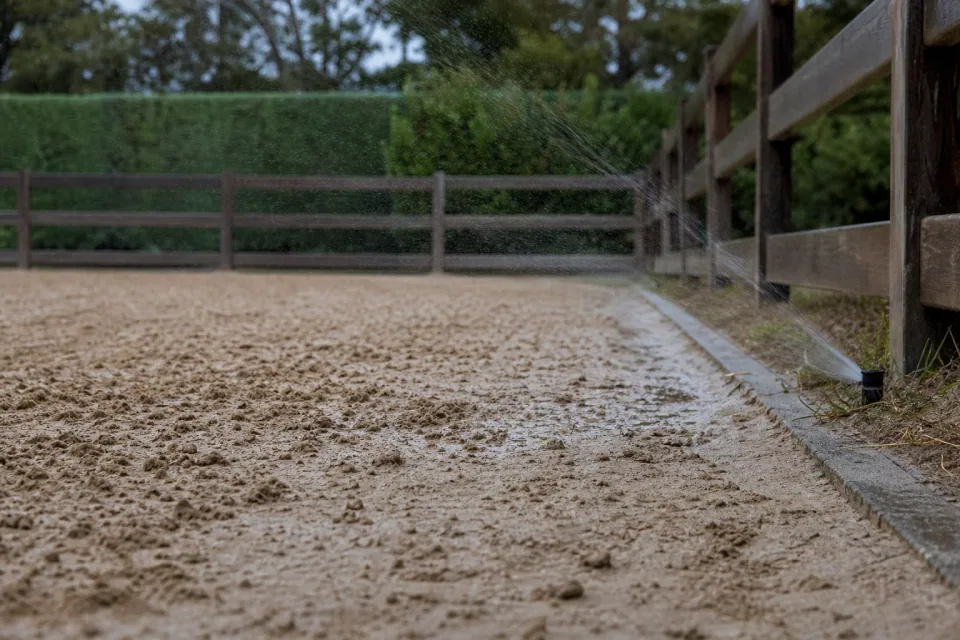
Record conditions before and after routine watering and grooming. Note whether dust appears across the whole ring or on heavily traveled lines and whether it returns quickly. Record changes in material, use, weather and equipment settings. Dry surface material, breakdown of particles and contamination can all contribute. A specialist can help distinguish the causes before recommending replacement.
Match watering to the material and site
Moisture can help bind loose particles and affect how a surface behaves under use. Watering needs vary with the material, weather, cover and intensity of riding. Follow the supplier's guidance and monitor the surface rather than choosing a universal water quantity. Ask whether the current distribution system reaches the whole riding area consistently.
Too much water or uneven application may create different problems. If puddles persist or runoff enters the arena, investigate the drainage system rather than treating dust and standing water as unrelated issues.
Consider the full maintenance system
- Review grooming depth and settings with the supplier; avoid disturbing the foundation.
- Record material additions and remove manure and debris.
- Check irrigation coverage and water availability with the appropriate specialist.
- For enclosed rings, discuss ventilation and humidity with building professionals.
- Ask for safety data and compatibility information before using any proposed dust-control additive. Avoid experimenting with unverified chemical treatments.
The routine arena care guide provides a broader maintenance baseline.
When is resurfacing worth discussing?
If dust returns despite appropriate care, ask whether the existing material is breaking down, has become contaminated or is incompatible with the intended use. Request a material evaluation, a representative replacement sample, and an explanation of how the proposed surface will be maintained. Do not assume a fiber additive or expensive blend will fix a failing base or unsuitable sand.
Consider footing materials and the replacement cost worksheet guidance before choosing a new layer. Seek appropriate occupational or veterinary advice for exposure or health concerns; do not ride in conditions that are unsafe.
Prepare a useful resurfacing inquiry
Provide dimensions, current material, riding frequency, watering method, grooming equipment, and the pattern of dust or recurring unevenness. Explain what you have already tried and the maintenance resources available. A footing specialist can use that information to scope a surface evaluation. Standalone irrigation installation or routine grooming is outside the initial referral focus.
Plan your next arena project
Describe the property, work needed and your preferred timing. You can include dimensions and budget if known.
Project enquiriesSources and further reading
- University of Georgia Cooperative Extension — The Dirt on Arena Footing, October 2023 (reviewed November 24, 2026)
- French Institute for Horses and Riding (IFCE) — Designing an Arena (technical background, not South Carolina code; reviewed November 24, 2026)
- IFCE — Designing an Indoor School (technical background; reviewed November 24, 2026)